Fixed stars and asteroids
Add supported fixed stars and minor bodies and understand the available catalog limits.
On this page (5 sections)
Fixed Stars, Parans and Extended Bodies answer different questions about additional objects. Begin with Iris Vale's saved chart and keep the natal birth time and London location unchanged as you move among them. A conjunction in zodiacal longitude is not the same kind of relationship as a paran. Use the view name and its controls when recording an example.
Show extended bodies on the wheel
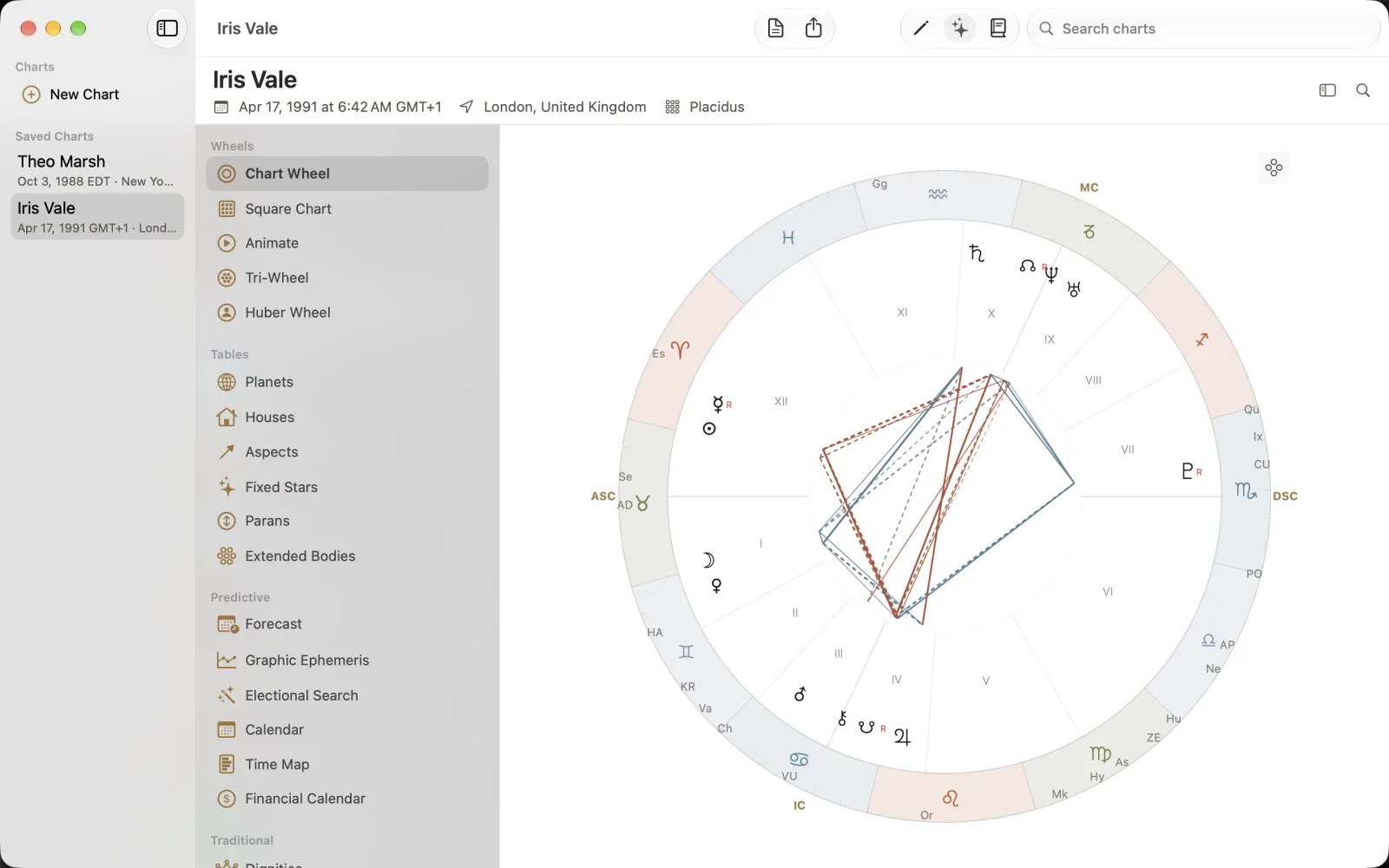
On Chart Wheel, choose Extended Bodies, the sparkle control. The example shows an accent tint and two-letter labels around the outer ring. The small button within the wheel instead toggles midpoint markers. Extended Bodies can be disabled when unavailable for the chart, such as a composite.
Select Iris Vale and open Chart Wheel.
Turn on Extended Bodies in the toolbar.
Open Extended Bodies under Tables to check what the short labels represent.
Match the codes to the selected bodies
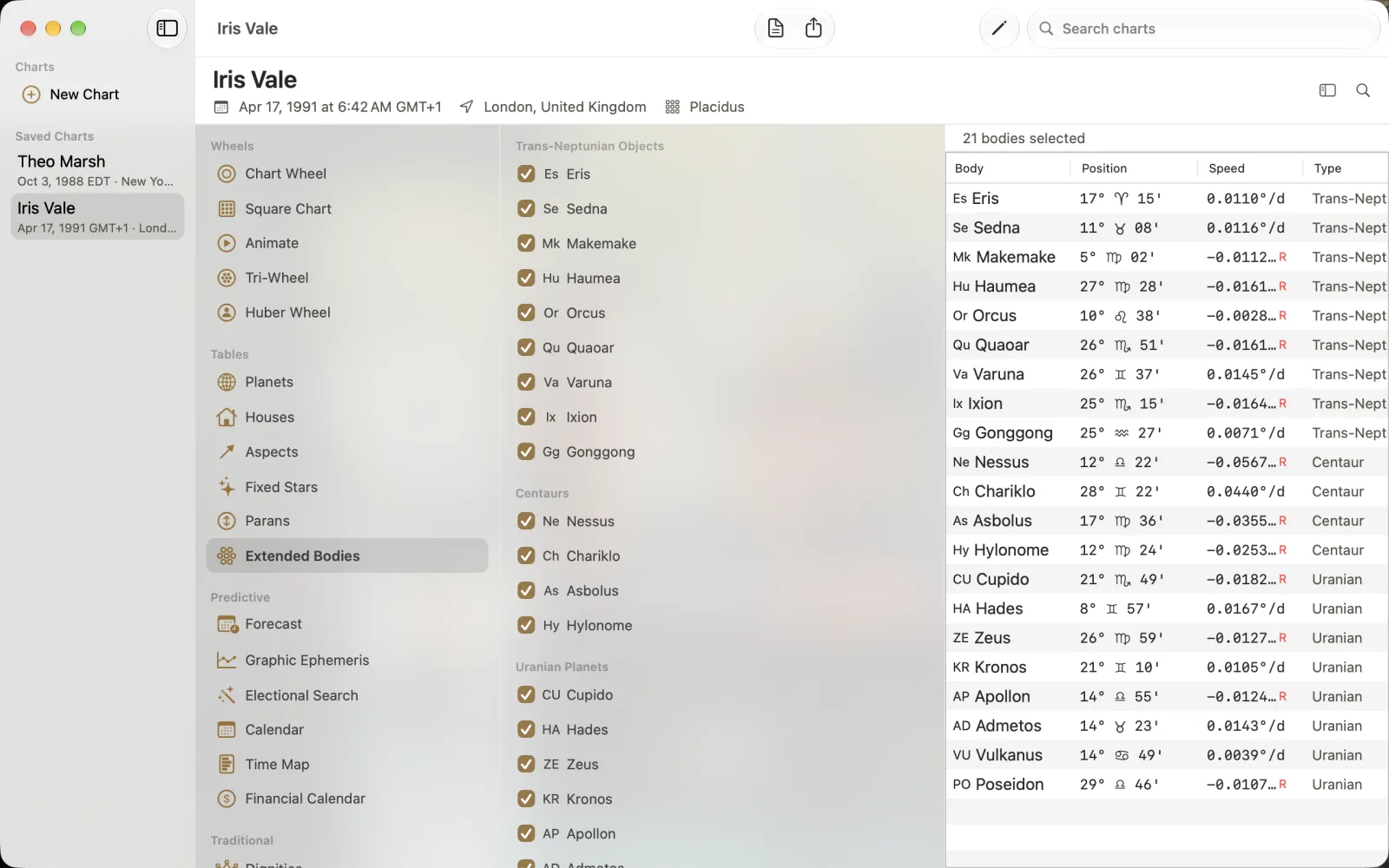
The example has 21 bodies selected, grouped as Trans-Neptunian Objects, Centaurs and Uranian Planets. The codes match the wheel labels. Read Body, Position, Speed and Type together; an R marks retrograde motion. A checked object is part of this selection, not evidence that every named asteroid is available.
Inspect fixed-star conjunctions
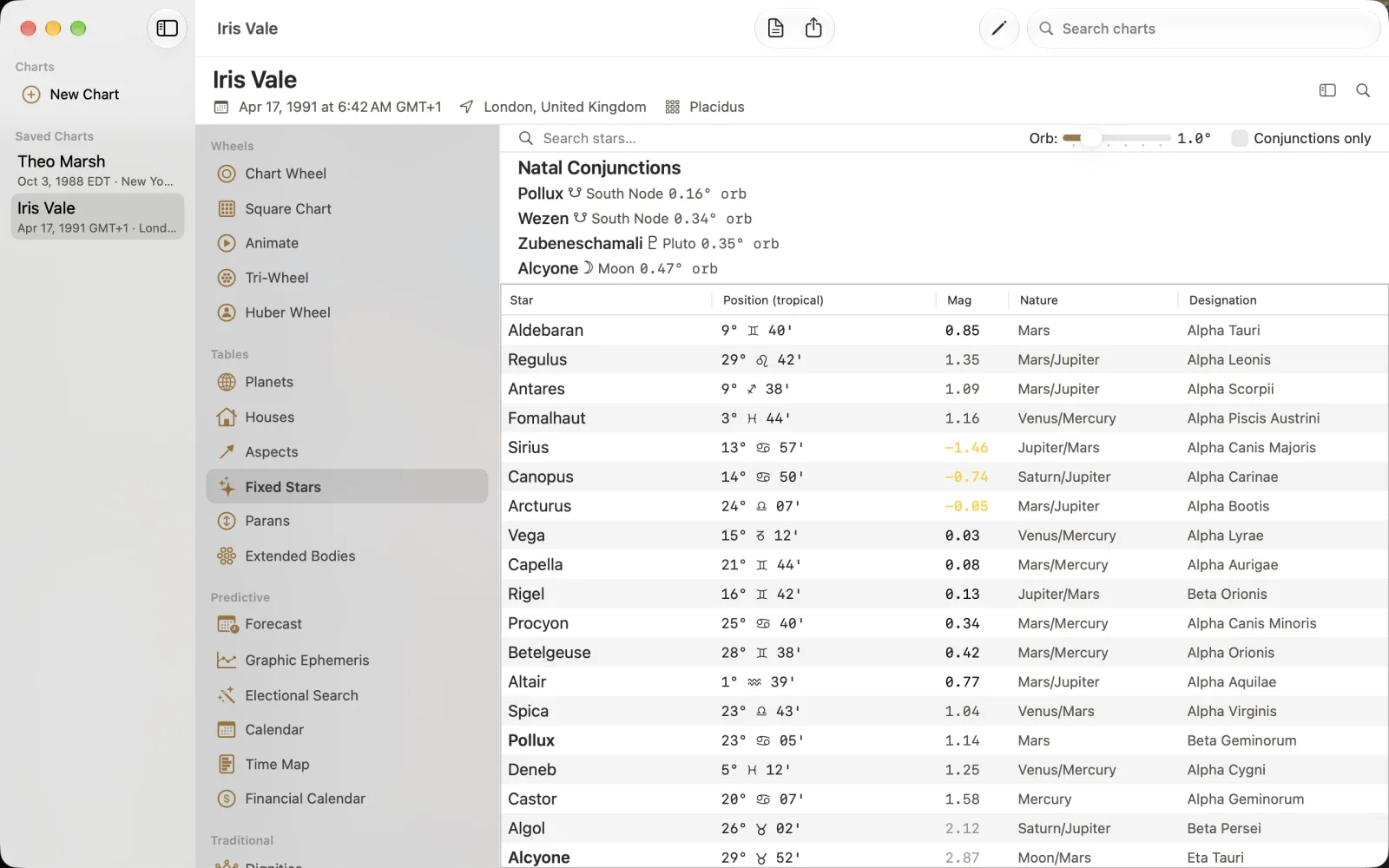
Open Fixed Stars and check Orb, shown at 1.0 degrees, plus Conjunctions only. Search stars... narrows the catalog. Natal Conjunctions includes Alcyone with Moon at orb 0.47 and Pollux with South Node at 0.16 in this example. The catalog columns include tropical Position, Mag, Nature and Designation.
Read the paran approximation warning
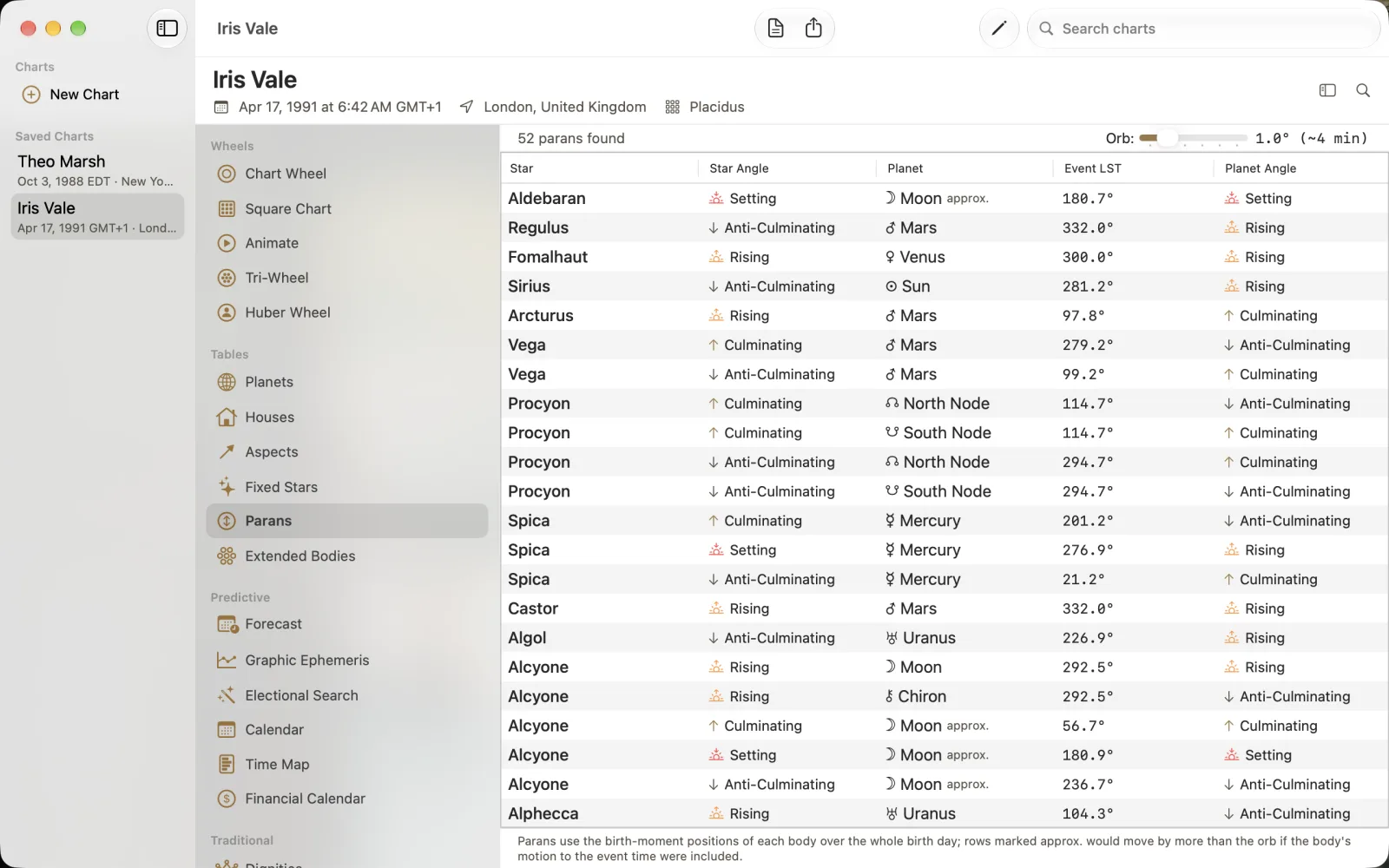
Choose Parans. The capture shows 52 parans found and Orb 1.0 (~4 min), with Star Angle, Event LST and Planet Angle. The footnote says birth-moment positions are used over the whole birth day. Rows marked approx. would move by more than the orb if motion to the event time were included. Keep that qualification with any such row.